2025 Dates: Dec 22nd, 23rd, 24th, 29th, 30th, 31st, Jan 2nd
For more details, click Grammar Workshop (P1 to P5) to download the registration form or visit www.miniminds.com.hk/christmas-workshops/.
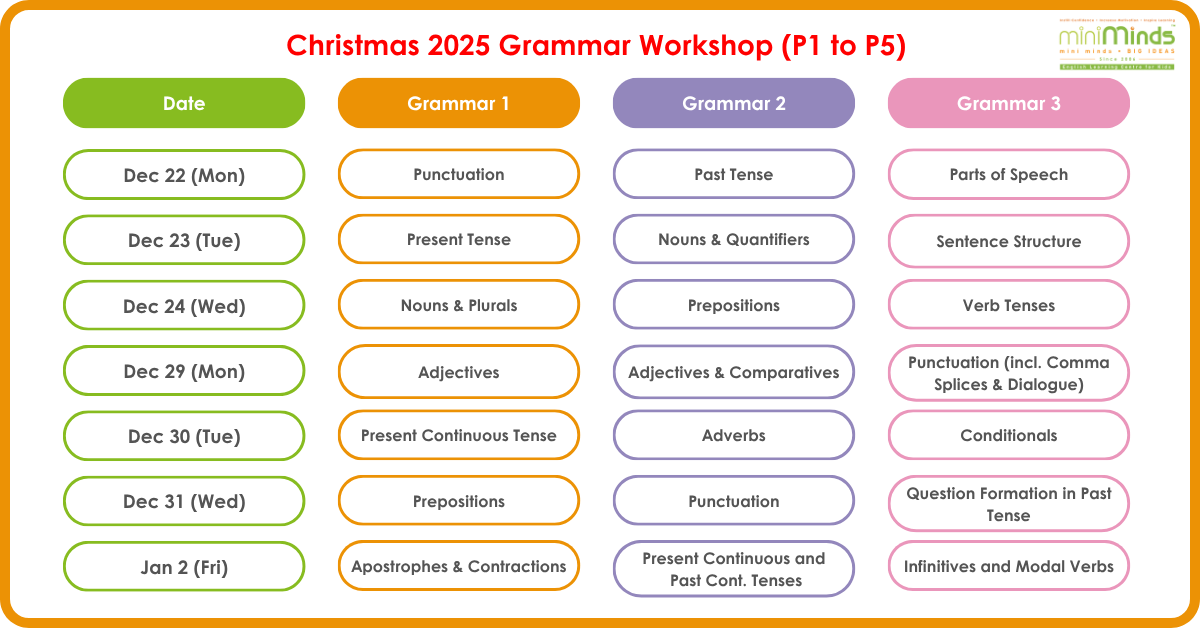
Every Christmas Grammar lesson explains the rules through interactive discussion and pictures alongside clear exercises, then includes a short writing task (to apply the concepts) and proofreading practice.
Grammar 1
*All of the lessons also include applying the day’s grammar points in a one-paragraph short writing task (usually a story) and practising proofreading.
- Punctuation: Students will review when we need capital letters then practise using exclamation marks and question marks with full sentences. After that, they will learn the rules for commas when using time words or lists.
- Present Tense: The rules for simple present tense include when we need to add ‘s’ or ‘es’/’ies’ to verbs, then students will practise both identifying and writing these.
- Nouns & Plurals: After learning what a noun is and finding them, students go over the different ways to make plurals – with ‘s’ like “biscuits,” with ‘es’ such as “beaches,” with ‘ies’ as in “berries” and some irregular plurals like “children.” They will also practise using “There is” and “There are,” which are common English errors in Hong Kong.
- Adjectives: Beyond what an adjective is, students will discuss some of the patterns for making and spelling them such as luck—lucky, shine—shiny, and chat—chatty. We will also go over the “-ed” vs. “-ing” confusion so students can correctly use “amazed” vs. “amazing” and similar adjectives.
- Present Continuous Tense: Breaking it down step-by-step, students will practise using is/am/are before the “-ing” form of the verb as well as the trickier spelling rules such as dropping the ‘e’ and when to double the consonant.
- Prepositions: These small words are often the source of grammar confusion, so students will start with prepositions of place and direction such as “beside,” “into” and “through” then move on to prepositions of time including how to use “on” for a specific day but “in” for larger amounts of time such as months.
- Apostrophes and Contractions: Students will unravel mysteries of why and where we need apostrophes in words like “he’s,” “they’re,” “she’ll” and “don’t.” Next, we’ll review the unrelated possessive use, such as “Rachel’s hair” or “the spider’s legs” – including what to do when there is already an ‘s’ because of a plural!
Grammar 2
*All of the lessons also include applying the day’s grammar points in a one-paragraph short writing task (usually a story) and practising proofreading.
- Past Tense: After reviewing the d/ed/ied rules for regular past simple tense and putting them in practice, the focus will shift to irregular past simple tense, where there are no rules but some helpful patterns we can use for guiding students towards correct usage.
- Nouns and Quantifiers: Starting with identifying common nouns vs. proper nouns, students will learn about what it means for a noun to be countable or uncountable and which quantifiers (including some, many, any, a few) can be used with them.
- Prepositions: These words may seem short, but they are not always easy. Students will practise using the rules for correct prepositions of time (including “at,” “on” and “from… until”), various prepositions of place from the simple “on” to the trickier “above,” and prepositions of direction (do raindrops fall “down” the sky, or “from” the sky?).
- Adjectives and Comparatives: Beyond understanding which words are adjectives, the goal is for students to be able to deploy them correctly, including the key “-ed” vs “-ing” difference and making comparisons (including why we write “easier than” but “more interesting than”).
- Adverbs: We will examine several different patterns for forming adverbs from adjectives (why is it “angrily” but “enjoyably”?), then move on to how comparative adverbs work and when to use adverbs of time.
- Punctuation: Four different reasons to use a comma in various sentence structures, when to capitalise “mum” and “dad” – and why – along with how to punctuate characters’ dialogue all feature in this lesson.
- Present Continuous and Past Continuous Tenses: Does your child understand when to use “are listening” instead of “is listening,” and how “was reading” can be correctly used together with past simple in a useful sentence structure? We will briefly review the basics of how to form these two tenses but also look at when they are needed.
Grammar 3
*Each of the lessons also includes applying the day’s grammar points in a one-paragraph short writing task (usually a story) and practising proofreading using a story about a wacky scientist’s inventions.
- Parts of Speech: Students at this level have certainly heard about nouns, verbs, adverbs and adjectives before, but now they will practise looking at the context to figure out which one applies (for example, why is “smile” a verb in “she smiles” but a noun in “a smile spread across her face”?) Feeling comfortable with these categories is important for comprehending further grammar rules.
- Sentence Structure: Incomplete sentences are a frequent type of grammar error, so students will review simple sentences, examine compound sentences, and identify subjects / predicates to figure out whether their sentence is correct and whether they need a conjunction.
- Verb Tenses: As a refresher, this is a tour through present simple, past tense, and past continuous, with reminders about why we use each one, irregular verbs and the rules for regular verbs.
- Punctuation (incl. Comma Splices & Dialogue): Sorting out confusion about three different situations when we use commas, looking at how to use speech marks with capital letters and commas for dialogue, and avoiding the dreaded mistake of a comma splice are all part of the plan for this lesson.
- Conditionals: “If” statements are important for both imagination and answering many comprehension questions, so we will dive into how to correctly use first conditional (“if… will”) and second conditional (“if… would”), including which tenses to apply.
- Question Formation in Past Tense: We will not only review inverting the word-order (“He was running.” vs. “Was he running?”) but also go over other ways to make questions in past tense, such as question tags.
- Infinitives and Modal Verbs: Sometimes, the trick is that the verb that doesn’t change! Students will learn why “he decided to think” is correct (not “to thought”) and what to do with modals, such as “might” and “should,” which require an unchanged verb after them.