
2026 Dates: Dec 21st, 22nd, 23rd, 24th, 28th, 29th, 30th, 31st
For more details, click Grammar Workshop (P1 to P5) to download the registration form or visit www.miniminds.com.hk/christmas-workshops/.
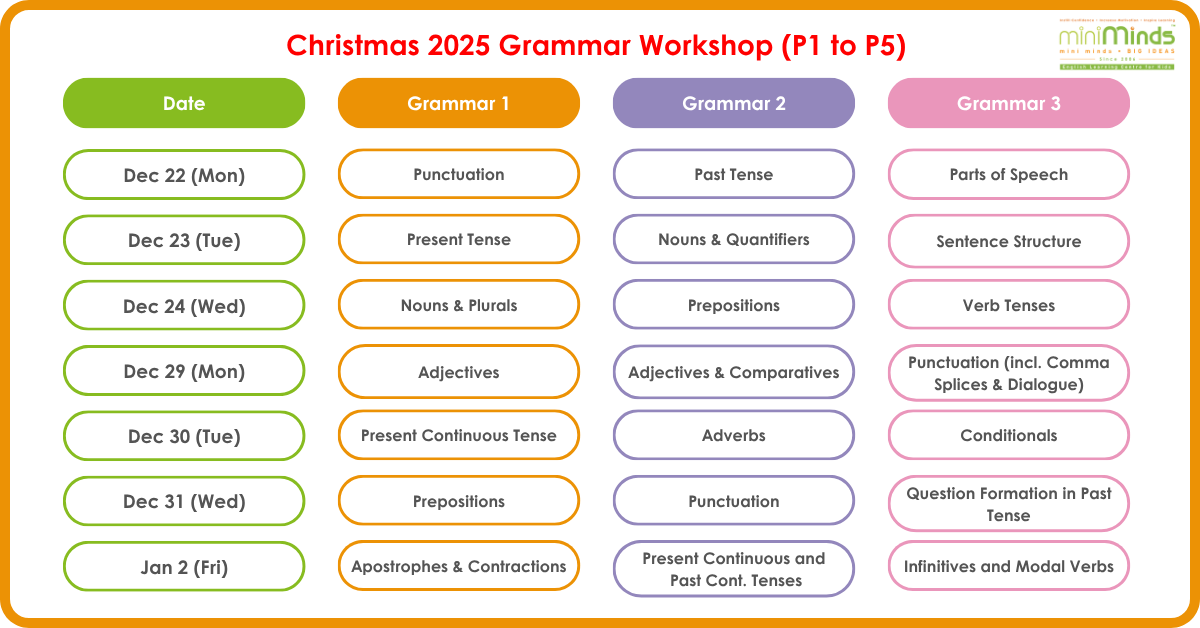
Every Christmas Grammar lesson explains the rules through interactive discussion and pictures alongside clear exercises, then includes a short writing task (to apply the concepts) and proofreading practice.
Grammar 1
*All of the lessons also include applying the day’s grammar points in a one-paragraph short writing task (usually a story) and practising proofreading.
- Present Tense: Beyond reviewing what a verb is and practising conjugation by adding “s” in he/she/it sentences, students work on the rules for “-es” (such as “washes”) and when to remove the “y” to add “ies” (“fly–flies”).
- Punctuation:Punctuation is much more than full stops! Students learn when to use question marks or exclamation marks, and they practise putting capital letters on every word of a proper name. We will also discuss and use the rules for commas in lists and after time-words.
- Be, Have, Do (Irregular Present Tense): Since students often make errors with “we have” vs. “it has,” or “he does” vs. “they do,” this lesson provides them with a solid foundation and lots of practice with these extremely useful irregular verbs.
- Present Continuous Tense: Students run through how to make present continuous sentences correctly, including correctly adding “-ing” to verbs. They will need to choose from “is/am/are” and learn spelling tricks like doubling the “n” in “running.”
- Apostrophes and Contractions: Apostrophes can get confusing, so we’ll review using them to show possession (Jayden’s pencil, the cats’ tails) and for contractions (you’re, she’s, hasn’t), including how to figure out where the apostrophe should go.
- Nouns and Plurals: After identifying nouns, we will focus on how to form plurals, particularly those which involve more than just adding “s” (think of “classes” and “people.”) Students will also practise the commonly-misused “there is” and “there are” phrases.
- Prepositions: Students learn what prepositions are and how to avoid common errors. For example, we use “on” for days (“on Friday,” “on my birthday”) and “in” for years (“in 2023”).
- Adjectives: Beyond understanding what an adjective is, students will transform nouns into adjectives by adding “y” and learn the spelling rules for this (“sun” to “sunny” and “taste” to “tasty”). They will also learn about the crucial difference between “-ed” and “-ing” (“I’m annoyed” vs. “I’m annoying!”)
Grammar 2
*All of the lessons also include applying the day’s grammar points in a one-paragraph short writing task (usually a story) and practising proofreading.
- Past Tense: Although it may be called “simple past,” we all know it isn’t simple! This lesson reviews the rules for different types of regular verbs broken down into clear chunks, guides students through practising some irregulars (which have no rules!) in an activity, and even shows them how to form past tense questions.
- Nouns and Quantifiers: Some nouns are countable and some are uncountable, controlling which quantifiers – such as “much,” “a few” or “many” – we can use. This lesson explains the concept, explores how to deploy these correctly, and then introduces the negative versions such as “there aren’t any.”
- Pronouns: Beyond just the subject pronouns “I/you/we/they/he/she/it,” these tricky little words can also become object pronouns such as “him.” We will discover how to spot the difference and then explore possession (his/her/their etc.) and when we need to use reflexive pronouns such as “herself.”
- Conjunctions: Students will review how to use “and / or / so / but / because” to join pieces of sentences together and extend their ideas, including when and where we must use commas, then progress to the less common “however, since, while,” and “although.”
- Punctuation: After revising the pieces needed to create a true full sentence (subject and predicate), we will dive into the details of where to place commas with conjunctions. How to correctly punctuate speech/dialogue, including the rules for when we need capitals and commas around quotation marks, is also covered.
- Past Continuous & Reported Speech: Why is it incorrect to say, “I was believing?” What is the grammatical difference between things that were happening at the same time versus something that interrupted another activity? Students will become more familiar with these, along with how to change tenses when we talk about what somebody said without quoting them (when “I am thrilled” becomes “He said he was thrilled.”)
- Future Tenses: English has many different ways to talk about the future! After examining “will” and “going to” constructions, we will look at modals like “have to” which can also express future plans.
- Prepositions of Time: Students refine and deepen their understanding of how to apply these deceptively tricky short words like “for” or “since” to discuss duration (how long…?), along with how to use “in” for indicating the future.
Grammar 3
*Each of the lessons also includes applying the day’s grammar points in a one-paragraph short writing task (usually a story) and practising proofreading using a story about a wacky scientist’s inventions.
- Past vs. Present Tenses: Although students have usually studied these tenses before, the details of when and how to apply them can be tricky! This lesson aims to not only review the basics but also deepen understanding of why we need past, past continuous, or present tense in particular contexts.
- Comma Splices & Complex Sentences: What truly makes a full sentence? One of the most common errors among advanced students is the comma splice, which is when sentences are joined together incorrectly using only a comma. We will investigate how to identify this, discuss different ways to fix it, and construct some correct complex sentences using patterns.
- Present Perfect Tense: Students are often understandably confused about using “have” to talk about completed (past) activities. We will examine when this is needed, along with practising the past participle form that goes with it (“broken, known, seen, done”) and touch on complexities of meaning like the difference between “has been to” and “has gone to.”
- Parts of Speech & Transformations: Identifying nouns, verbs, adjectives and adverbs is important for understanding all types of grammar rules, but many students are unaware of patterns (for instance, “-ment,” and “-tion” endings mean a noun)! Beyond these tips, students will also be guided through transforming words into other parts of speech, such as “concentration-concentrate” or “clarity-clear-clearly.”
- Past Perfect Tense: How can we show what happened before a past event? Introducing past perfect phrases like “the cat had stolen the key” can make creative writing clearer and more sophisticated. We will go into forming the past participle, which can be identical to past tense or different (e.g. “eaten, made, seen, gone”).
- Modals: Using these “helping verbs” goes far beyond remembering not to conjugate after “can.” This lesson reviews why and how to apply modals of both obligation and deduction such as “might, would, should” and more, including for writing about both present and past events.
- Advanced Introductory Phrases: Starting sentences with introductory phrases (such as “Fortunately, …” or “With a wide grin on her face, …”) can make writing sound much more mature in both stories and essays! Students will examine different types of introductory phrases and how to build the sentence structure correctly, including the right punctuation.
- Common Grammar Errors: This lesson reviews the small things that often go wrong in students’ writing, including the “there-their-they’re” difference, comparatives (when to use “more …” instead of “-er,” such as “softer” and “more comfortable”), and a quick look at countable vs. uncountable nouns.